

Dr. Sindhu Shantha Nair
Humanism
As a doctrine humanism is centered upon human interests and/or values. It is a philosophy that stresses the need for respecting each individual’s dignity, worth, and capacity, devoted to human welfare, and the human spirit, emphasizing secular concerns at large. This philosophical inquiry, contemplate human being for moral and philosophical inquiry, with due diligence to human factors rather than focusing on religious matters, or supernatural matters, with the basic tenet that human beings have an ethical responsibility to lead fulfilling lives, contributing to the greater good for all the people. It is a progressive philosophy, wherein human beings strive to lead a meaningful, ethical and fulfilling life.
Egalitarianism
The School of thought for egalitarianism under philosophy is that everyone is to be treated equally and no inequality amongst anyone should exist. While equal stands in economic resources, wealth, and contribution describe economic egalitarianism, equal respect and equal moral status in fundamental worth explain moral egalitarianism. Same law to all with no special privileges to individual or group applies to legal egalitarianism, and equal standing in political power or influence voices political egalitarianism as a founding principle of democracy. Distributive justice, outcomes of luck, and conscious options and their’ consequences describe luck egalitarianism, while equal power between genders qualifies as gender egalitarianism in society and family structure. The absence of racial segregation accounts for racial egalitarianism, equal opportunity amounts to opportunity egalitarianism
Feminism
Grounded in epistemology and phenomenology, oppression reigns as interpretivism and paradigms of criticism (Egbert & Sanden, 2019). While feminism as a movement is to eradicate sexism, exploitation, and oppression (Hooks, 2020, p8), the purpose of feminism is to clear oppressive systems and structures with transparency.
The end of the 16th century saw the defense of women as a subgenre, but the movement took a turn in England in 1589, when Jane Anger, the first feminist pamphleteer, wrote her opinion in ‘The Protection for Women’. This was followed by Mary Astell, in 1694 and a rejoinder in 1697 as “A Serious Proposal to the Ladies”2. The 17th century saw the declaration of women as equal and partners (de Gouges, 1791), and that women were given equal opportunities in education, work, and politics (Wollstonecraft, 1792). It is an interesting fact that Mary Wollstonecraft (1792) vouched for women as rational as men and that society trains them to be irrelevant and silly. The revolutions in each country applied concepts of equality and freedom for women, calling for tumultuous social change by mid 19th century. All these movements created the convention for Women’s rights in 1848 in New York.2 In the ’60s and ’70s, feminist college-educated women took the movement further, with new dimensions of ‘equal pay, and ‘gender discrimination’. National, International, and ad hoc committees called for legal equity, college inclusion for female authors, to address women neutrally as ‘Ms’, and the establishment of collective centers for health crisis, rape victims, and women’s help, took lead.
Streams of thought in Feminism
Liberal
The liberal stream of thought was to bring about change at the governmental and institutional level, to have more women in male-dominated areas, to have equality in the number of women versus men in positions, sports (inclusion and financial spend), and special consideration for workplace benefits for mothers and the like.
Radical
The main aim of radical feminism was to reform, reshape and restructure society, and its institutions, which were traditionally patriarchal. The social fabric was subservience for women in an inherently male-dominated society.
Cultural
This cultural notion dismissed the dissent of men and women being the same and instead spread the aspects of difference in men and women, their qualities as innate and inherent as nurturing, emotional strength, to accept those feminine qualities and not to compete for what is innate.
Developed vs Developing Countries in feminism
Countries equally vied for women’s rights, feminism, and influencers globally communicated and debated endlessly on these issues, dissenting on the concept, though the geo-political, economic and cultural situations deeply interfered with transparency and execution.

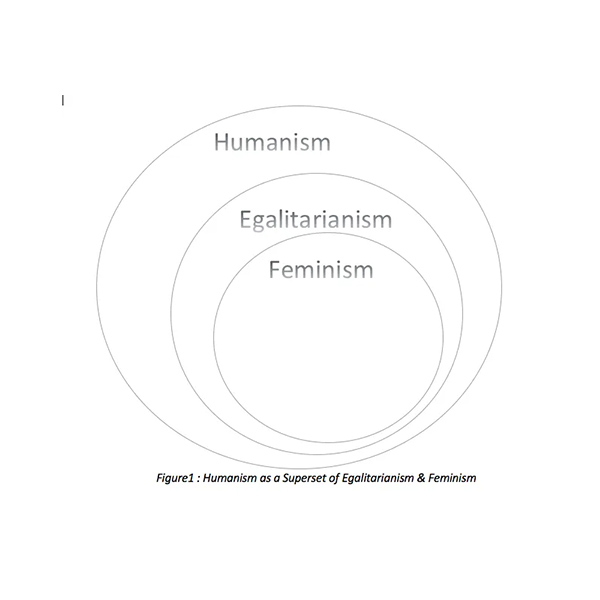
To surmise, the concept of feminism mainly focused on gender and discrimination. Oppression of women and minorities is still in society, for which awareness of this oppression, rights to women in society, humanism, and right to speech have to reach further to the society at large (Egbert & Sanden, 2019). Egalitarianism stipulates that all people are to be treated equally with rights and opportunities. This clearly pictures, humanism as a superset of egalitarianism and feminism (Figure 1). While feminism centrally focuses on gender discrimination elimination, egalitarianism is equality in opportunity, which clearly makes feminism a subset of egalitarianism. Even when society claims to be achieving equality in opportunity and zero tolerance for gender inequality, still there are huge gaps that are glaring in terms of socio-political equality. Nevertheless, humanism is an agency of human beings, with a progressive mindset, a philosophy, on the human realm through a legislative structure, entrenched in exponential technological and economic development for the benefit of all people within the concept of panhumanism3.
The urgent need of the hour in education is that there should be no gender discrimination (feminism) awareness of equal opportunities (egalitarianism) in personal and professional settings, to live peacefully, and for goal actualization to heal, live and let live (Humanism).
Reference
Hooks, B. (2000). Feminism is for everybody: Passionate politics. South End Press.
Egbert, J., & Sanden, S. (2019). Foundations of education research: Understanding theoretical components. Taylor & Francis.
De Gouges, O. (1791). The Declaration of the Rights of Woman., https://worldhistorycommons.org/olympe-de-gouges-declation-rights-woman-september1971
Egbert, J., & Sanden, S. (2019). Foundations of education research: Understanding theoretical components. Taylor & Francis
Egalitarianism — By Branch / Doctrine — The Basics of Philosophy (philosophybasics.com)
feminism | Definition, History, Types, Waves, Examples, & Facts | Britannica, Elinor Burkett in Feminism, www.britannica.com
The Intersection of Feminism and Humanism — Kurtz Institute
Wollstonecraft, M. (1792). A Vindication of the Rights of Woman with Strictures on Political and Moral Subjects. https://www.bartleby.com/144/
Dr Sindhu Shantha Nair
Humanism a superset of Egalitarianism & Feminism | by Dr Sindhu Shantha Nair | Medium